

Experience Design
Halls of Fame
We Are Not Thinking Machines That Feel

I want to tell you about a room full of five hundred donors who hadn’t opened their wallets in three years.
It was an American Heart Association dinner. James Franklin, then head coach at Vanderbilt, stood at the podium. The room expected statistics about heart disease, data on survival rates, the usual ask dressed up with slides. What they got instead was a story about a mother who had to walk to the window to read a piece of paper.
“I drove to their apartment with the scholarship offer,” James told the room, his voice catching slightly. “Full ride. Vanderbilt education. Everything covered. The mother took that paper from my hands and walked straight to the window. She had to. It was the only light in the apartment.”
The room went silent. You could hear five hundred hearts breaking and rebuilding simultaneously.
“She stood there, holding that paper up to the fading daylight, tears streaming down her face. Not because of what was written on it. The words, the numbers, the terms, none of that mattered. What mattered was what it meant. That paper was transformation. That paper was her son’s future. That paper was light in a dark room.”
Thirty seconds later, that ballroom raised more money in one evening than they had in the previous three years combined.
Logic didn’t open those wallets. Data didn’t move those donors. A story about a mother reading by the window did.
If you want to understand why, you need to understand how human beings actually make decisions. Not how we like to think we make them. How we actually do.
The Science Your CFO Won’t Like
A professor of mine at Vanderbilt loved to quote Antonio Damasio: “We are not thinking machines that feel, rather, we are feeling machines that think.”
Damasio studied patients who had suffered injuries to the emotional regions of their brains. These weren’t people who had lost intelligence. They could still analyze, calculate, and reason. Give them a logic puzzle and they’d solve it. Give them data and they’d process it perfectly.
Give them a decision to make? They couldn’t.
Simple choices, where to eat lunch, which shirt to wear, when to schedule a meeting, became impossible labyrinths. One patient spent thirty minutes analyzing the pros and cons of using a blue pen versus a black pen. Another couldn’t choose between two dates for an appointment, listing endless rational reasons for and against each option but never landing anywhere.
The revelation was staggering: we don’t make decisions despite emotion. We literally cannot make them without it.
“We are not thinking machines that feel. We are feeling machines that think.” — Antonio Damasio
Damasio called it the somatic marker hypothesis. Your brain tags every experience with an emotional marker, a gut feeling. When you face a decision, those markers fire before your conscious mind even engages. That feeling in your stomach when something seems off? That excitement when an opportunity feels right? Those aren’t distractions from good decision-making. They ARE decision-making.
The head explains. The heart decides.
Your CFO may not like this. Your board might resist it. But the science is undeniable, and the implications for how you build experiences are profound. Emotion doesn’t cloud judgment. It enables it. When emotion is damaged, decision-making stops. When emotion is engaged, decision-making accelerates.
The CEO Who Thought Hospitals Were Chosen Rationally
I remember sitting with the CEO of a major healthcare system who was convinced that choosing a hospital was a rational decision. “People compare survival rates,” he insisted. “They evaluate our technology. They research our physicians’ credentials.”
“Maybe,” I said. “But they choose based on whether the receptionist smiled at their mother.”
He looked at me like I’d lost my mind. So I told him what we’d seen in our StoryMining sessions across healthcare organizations. When we ask employees why their institution matters to them, we don’t get answers about clinical outcomes. We get something much more personal.
We get the story of a woman at Wake Forest Baptist Medical Center who wasn’t a patient, she was staff. But her son had been a patient his entire life, fourteen years of treatments, fourteen years of driving to the same hospital, parking in the same lot, walking through the same doors. Fourteen years of hoping her son would reach the kind of independence that other parents take for granted. A door closing. Privacy. The small, enormous dignity of a fourteen-year-old boy using the bathroom by himself.
The moment her voice cracked in that StoryMining session wasn’t when she talked about clinical excellence. It was when she described the day her son closed that bathroom door for the first time.
The room went silent. Everyone there, executives, administrators, clinicians, all of them knew exactly what that closed door meant. That every early morning, every late shift, every impossible day had added up to something a spreadsheet could never capture.
That transformation didn’t happen through logic. It happened through a closed door. Through a boy’s dignity. Through the emotional truth that healthcare isn’t about treatment plans. It’s about the moment the plan finally works.
Is that a data point? No, it’s a decision-maker. The kind of truth that reshapes how an entire organization understands its own purpose.

Four Things Emotion Actually Does (That Logic Cannot)
Emotion gets a bad reputation in business. We talk about someone being “caught up in emotion” or making “emotional decisions” as though these are failures of judgment. The research tells a very different story.
Emotion drives decision-making. We’ve established this through Damasio’s work. Without emotional input, the brain cannot push past analysis into choice. This is not a bug in human wiring. It’s the feature.
Emotion increases persuasion. When we have a genuine affective response to something, an experience, a moment, a story, we become more loyal to it. Research on emotional engagement consistently shows that a positive emotional response accelerates commitment in ways that rational argument alone never achieves.
Emotion increases attention. Not just captures it momentarily but sustains it. Think about the difference between glancing and gazing. Between hearing and listening. Between being in a room and being truly present in it. Emotion is what makes the difference.
Emotion enhances memory. A 2004 study by Dolcos and colleagues demonstrated that emotional content enhances both memory encoding and retrieval through amygdala-hippocampal interactions, with emotional memories showing significantly better retention than neutral ones. This is why you can recall exactly where you were on certain days years ago, but cannot remember what you had for breakfast last Tuesday.
Are these theories? No, they’re biological facts that have a direct implication for how you design every touchpoint your audience has with your organization.

You Felt It First. Then You Found the Reasons.
Think about the significant decisions in your own life. Where you work. Who you married. What causes you support. What you believe in.
You felt those first. Then you found the reasons.
The car that made you feel successful. The college that made you feel like you belonged. The company that made you feel valued. The cause that made you feel purpose. In every case, emotion came first. Logic followed to justify what the heart had already decided.
We keep pretending humans are computers when we’re actually something far more complex. We build presentations full of features and benefits when we should be building bridges to feelings and belonging. We act like decisions happen in spreadsheets when they actually happen in souls.
Think about the Yeti sticker on the back of someone’s truck. The Apple sticker on someone’s Prius. Those vehicles weren’t made by those brands. But people are so emotionally committed that they’re willing to become mobile billboards. They’re not advertising products. They’re declaring identity. That tribal belonging, that emotional identification, drives long-term loyalty in ways that a list of rational benefits never could.
You can’t argue someone into loyalty. You can’t spreadsheet someone into love. You can’t PowerPoint someone into passion.
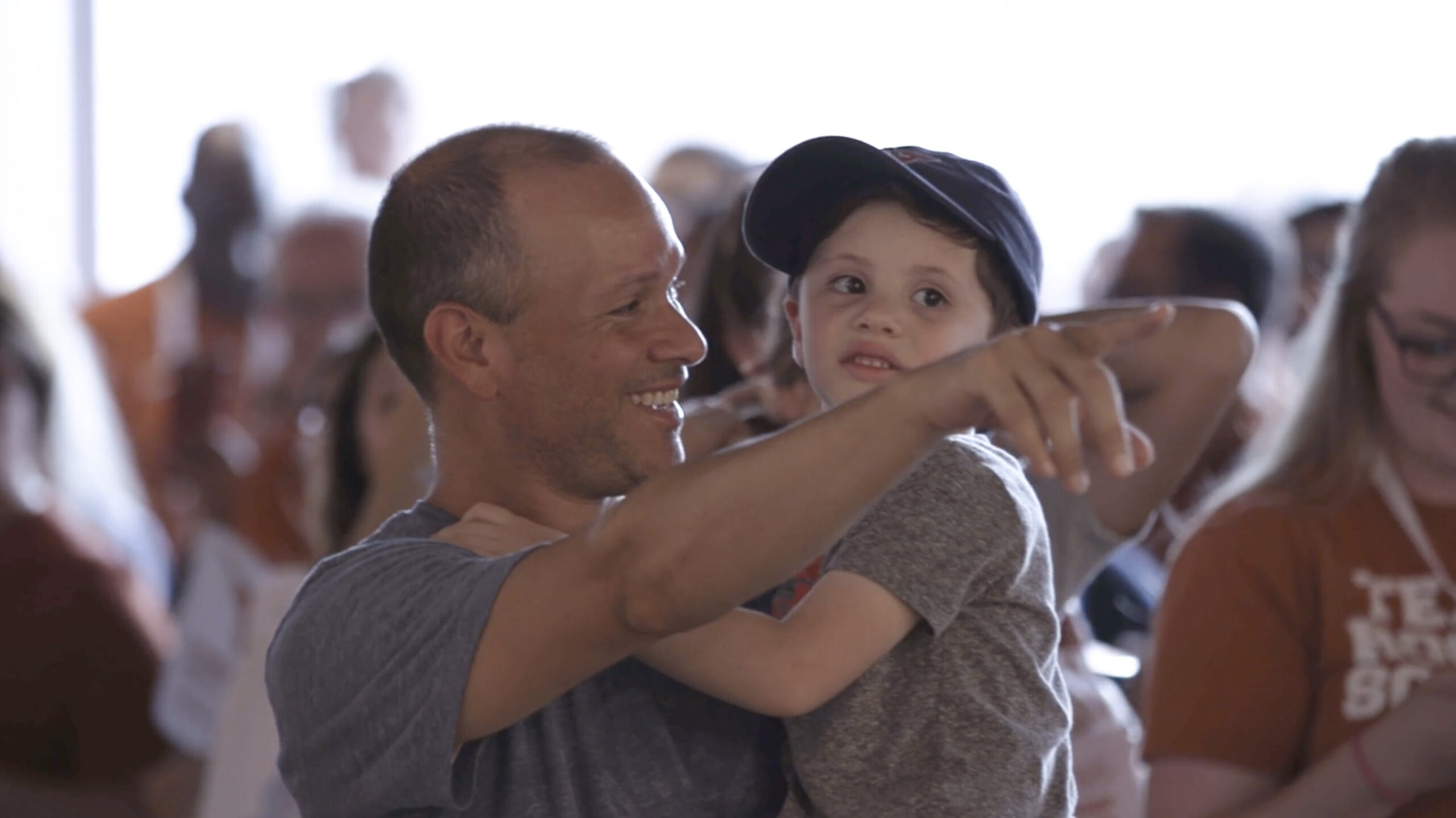
Experience Is the Bridge
So what do you do with this? If emotion drives every significant decision, and messages largely fail to create emotional response, how do you actually move people?
Experience is the bridge between understanding and believing, between knowing and caring, between considering and committing.
At USC’s Heritage Hall, we didn’t just install a timeline and some trophy cases. We embedded a bronze sword in a Greco-Roman column at the end of the path every player walks to practice. We put Heisman trophies out in the open, no glass, no barriers, just a security tether. Players started touching the sword before practice without being asked. Visitors started mirroring the Heisman pose next to the trophies, hundreds of thousands of photos now exist of fans doing exactly that. Nobody designed those behaviors. We designed the conditions that made those emotional responses possible. The experience did the rest.

At Wake Forest Baptist, after that StoryMining session, the story of the closed bathroom door became central to how that organization understood and communicated its own mission. Not because we told them to use it. Because when you surface an emotional truth that specific and that real, it travels. It becomes the story people tell about why they show up. It becomes the standard against which every decision gets measured.
That’s what experience does that messaging cannot. It doesn’t tell people what to feel. It creates conditions where the feeling is inevitable. And once someone feels something real in connection with your organization, that feeling encodes itself into memory in a way no brochure, no website, no campaign ever will.
Your brain requires emotion to choose. Without it, you can analyze forever and never decide. With it, you can move from maybe to yes in the time it takes for a tear to form.
That’s not manipulation. That’s understanding how human beings actually work, and building experiences worthy of how we’re wired.

For over 25 years, Advent has been creating emotionally resonant experiences for leading brands including AT&T, Fanatics, the Dallas Cowboys, and Stanford University. Our proprietary StoryMining methodology ensures that every project starts with the story, not the technology.